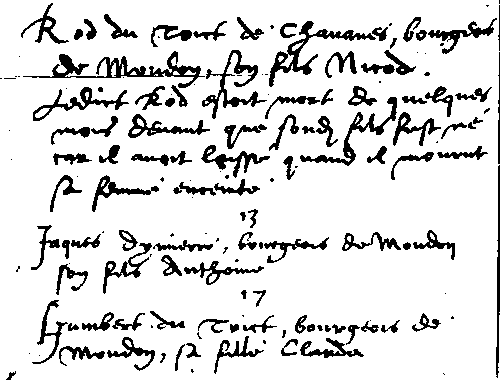
                     [3 Aoust 1582]
   Rod du Toict de Chavannes, bourgeois
     de Moudon, son fils Nicod.
   Ledict Rod estoit mort de quelques
   mois devant que sond[it] fils fust né
   car il avoit laissé quand il mourut
   sa femme enceinte.
                     13 [Aoust]
   Jaques Dymierre, de Moudon
     son fils Anthoine
                     17 [Aoust]
   Humbert du Toict, bourgeois de
     Moudon, sa fille Clauda
                     [3 August 1582]
   Rod du Toict of Chavannes, citizen
     of Moudon, his son Nicod.
   The said Rod died several
   months before his said son was born
   for he had left when he died
   his wife pregnant.
                     13 [August]
   Jaques Dymierre, of Moudon
     his son Anthoine
                     17 [August]
   Humbert du Toict, citizen of
     Moudon, his daughter Clauda
This is a beautiful example of the old handwriting style typical of church and notarial records in some districts. Once you learn the alphabet, it is a pleasure to read if neatly done. In its messier specimens, though, you might think you were looking at someone's unsuccessful knitting project. The spelling in this sample uses the most common 16th Century forms.
The 4th word of the 4th line, transcribed as "sondit", shows one of the most common shorthand forms. The descending squiggle attached to the "d" is used to represent the word "dit" (at that time usually spelled "dict", ultimately from Latin "dictus"). There is a whole family of "dit" words usually written with this modified "d" symbol, which can be translated by the English word "said". For example, "ledit Jean" (the said John), "susdit" (aforesaid), "lesdits parties" (the said parties), etc.
Moudon is close enough to Fribourg and Bern to show some German influences. Here we can see that the capital R is the standard version used today, not the old French script letter that looks like a V with two horizontal lines through it. Note that the letters "n", "v", and "u" may be indistinguishable. Because of this, one must sometimes study the whole series of parish registers for a commune to be sure that the surname is supposed to be, say, Chenevard, instead of Chevenard, which would look exactly the same in this script.