Latin Language and Script:
Sample Documents.
A Sample from Morges, Switzerland, 1425.
This sample is part of a "reconnaissance" (as this type of document was later called in French), in other words a "recognition" by a vassal of his or her obligation to pay a "census" or tax on property held in fief subject to a feudal lord or institution, in this case the Abbey of Romainmôtier. The vassal or "censier" (the person who pays the "census" or tax) is Henrieta, daughter of Roletus Journal, late citizen of Morges, and of Agnes daughter of the late Mermetus de Cubana, and Henrieta is now the wife of Petrus Foresterii, blacksmith of Morges. With the approval of her husband, she "recognizes" or acknowledges that she holds various properties for which she owes an annual tax to the Prior of the convent.
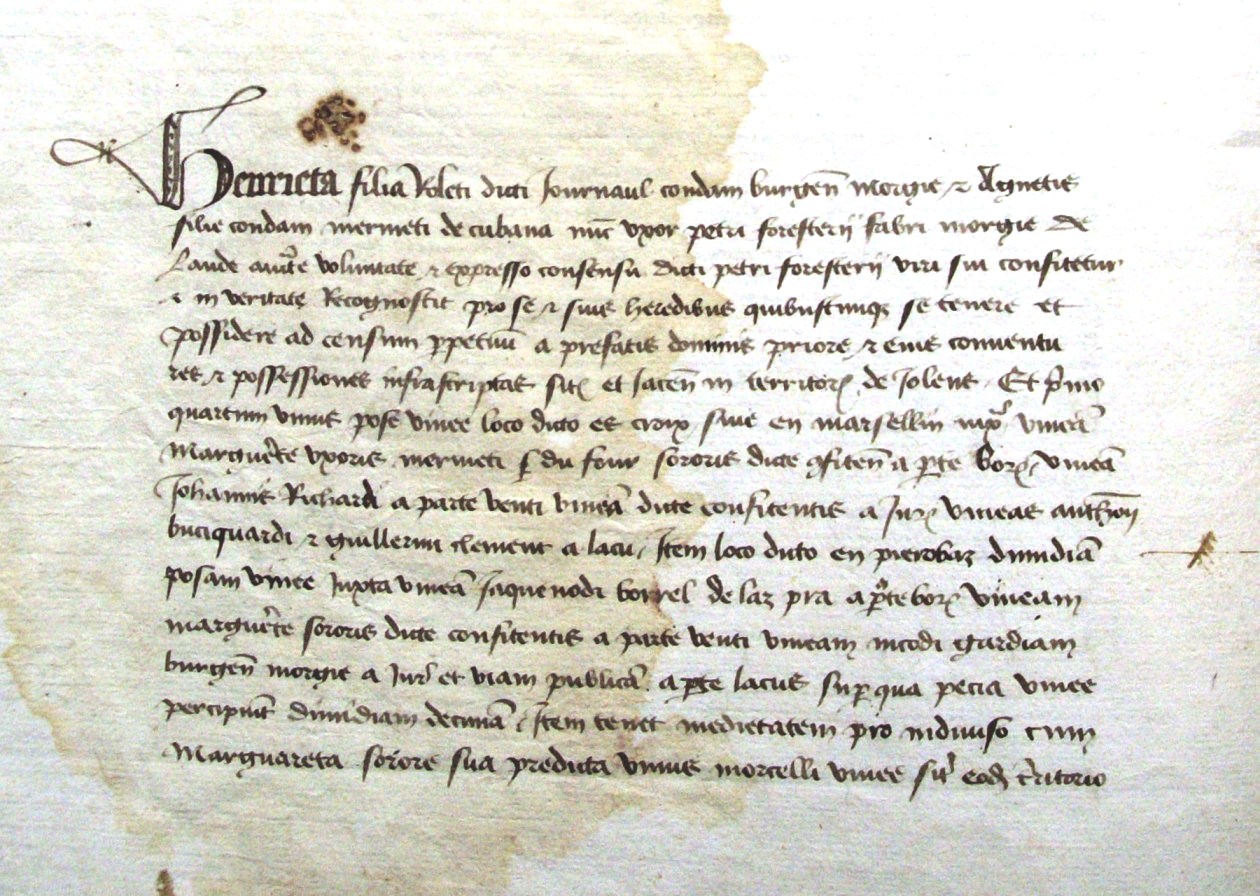
Transcription
Henrieta filia Roleti dicti Journaul condam burgensis Morgie et Agnetis filie condam Mermeti de Cubana nunc uxor Petri Foresterii fabri Morgie, de laude auctoritate voluntate et expresso consensus dicti Petri Foresterii viri sui confitetur et in veritate recognoscit pro se et suis heredibus quibuscunque se tenere et possidere ad censum perpetuum a prefatis dominis priore et eius convent res et possessions infrascriptas sitas et jacentes in territorio de Jolens, et primo quartum unius pose vinee loco dicto es Croux sive en Marsellin juxta vineam Marguerete uxoris Mermeti du Four sororis dicte confitentis a parte boree vineam Johannis Richard a parte venti vineam dicte confitentis a jurani vineas Anthonii Buciquardi et Guillermi Clement a lacu. Item loco dicto en Pierobaz dimidiam posam vinee juxta vineam Jaquenodi Borrel de laz Pra a parte boree vineam Marguerete sororis dicte confitentis a parte venti vineam Nicodi Gardiam burgensis Morgie a jurani et viam publicam a parte lacus super qua pecia vinee precipiunt dimidiam decimam. Item tenet medietatem pro indiviso cum Marguareta sorore sua predicta unius morcelli vinee situm eodem territorio…
Notes: This scribe frequently uses the spelling condam instead of the more usual quondam, meaning "the late", "deceased". By following
the word endings, we can see that Henrieta (nominative case) and not Agnes (genitive case) is the wife (uxor, nominative case) of Petrus Foresterii. The
descriptions of the various properties that she holds in fief from the monastery are described first by reference to the "territory" of a particular
village (Joulens), then by reference to a