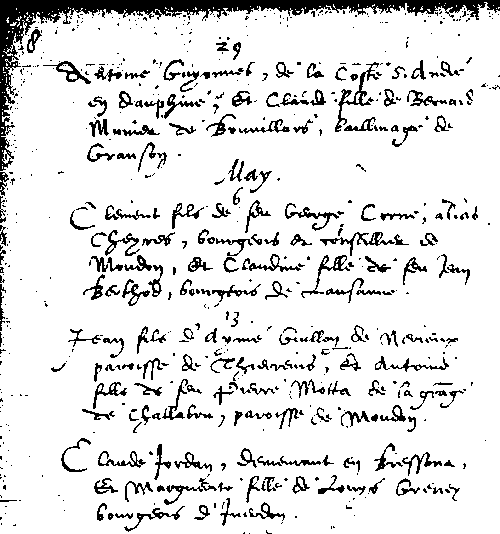
[page] 8           29 [Avril 1565]
   Antoine Guyonnet, de la Coste S. André
     en dauphiné, Et Claude fille de Bernard
     Munier de Bonvillars, baillivage de
     Granson.
                  May
                   6
   Clement fils de feu George Corne, alias
     Cheynes, bourgeois et conseillier de
     Moudon, Et Claudine fille de feu Jean
     Berthod, bourgeois de Lausanne.
                  13
   Jean fils d'Aymé Guillon de Nerieux
     paroisse de Thierrens, Et Antoine
     fille de feu Pierre Motta de la Gra[n]ge
     de Challabru, paroisse de Moudon.
   Claude Jordon, demeurant en Bressona,
     Et Marguerite fille de Louys Grevey
     bourgeois d'Iverdon.
[page] 8           29 [April 1565]
   Antoine Guyonnet, of La Côte St. André
     in Dauphiné, And Claude daughter of Bernard
     Munier of Bonvillars, district of
     Grandson.
                  May
                   6
   Clement son of the late George Corne, alias
     Cheynes, citizen and councillor of
     Moudon, And Claudine daughter of the late Jean
     Berthod, citizen of Lausanne.
                  13
   Jean son of Aymé Guillon of Neyreux
     parish of Thierrens, And Antoine
     daughter of the late Pierre Motta of La Grange
     de Challabru, parish of Moudon.
   Claude Jordon, living in Bressonaz,
     And Marguerite daughter of Louys Grevey
     citizen of Yverdon.
Provided you already know the place names and surnames of the area, this is a fine example of the old handwriting style. For example, the "n" and the "v" in Bonvillars are identical. The word could just as well be Bouuillars or Bonnillars! Without knowledge of actual place names, you're stuck! The only solution is to spend some time with the records. Study later records to learn the place names and surnames in something like modern handwriting, and study the old records to get used to the alphabet and the spelling variations. Notice that this record does not actually say "marriage" - that was indicated only on the first page of the register. But you can quickly see that you are looking at a list of marriages, because of the information given about each party.
With only two exceptions, every word in this example is spelled out. Saint is abbreviated "S.", and there is a line over the "a" in "grange" representing the "n" that has been left out. The capital "J" can represent either the modern "J" or the modern "I", as shown in the last entry. The same letter is used for "Jordan" and "Iverdon" (the latter a typical variant spelling of modern "Yverdon").
Two of the brides' fathers are deceased. Before the 19th Century, women frequently did not marry until their fathers had died, because the liquidation of the fathers' estates would help to create a dowry, and also because the family would now have a hard time keeping everyone under the same roof. The custom of the dowry and the marriage contract put even more of a premium on widows, whose assets included not only their original dowries, but also their late husbands' estates.
When a record says "bourgeois de Moudon", we may be sure the person was recognized as a citizen of Moudon. When the record says something other than "bourgeois", such as "demeurant", "residant", "habitant" (living in, resident, inhabitant), the implication is that he was not a citizen of the place, but was only living there. His citizenship presumably was held somewhere else. One of the challenges of genealogy in this area is to figure out where the person's hereditary citizenship belongs. For this reason, among others, it is important to study as many different records as possible, searching for all mentions of the person.
The vexing problem of "dit" names needs to be explained here. By the 16th Century, everyone in Vaud seems to have had a surname. In fact, some people seem to have had more than one! In the documents of the time, we find many people with two possible surnames. Sometimes both are listed, but in no particular order: Corne alias Cheynes, or Cheynes alias Corne. The French equivalent of the Latin "alias" is "dit" (or at this period, "dict"), and the practice of using alternative surnames is known as "dit names". These names seem to apply to a man who originated the alias, and all of his descendants (male and female), but in fact many records show only one of the possible names, with no indication that the person was known under a different name. The result is considerable confusion! The alias may represent a maternal surname, a nickname, a place name, or an occupation, but most of the time the exact origin will not be discovered. One or more generations later, the "dit" name may disappear altogether, in favor of one or the other of the original surnames. Here we have one more reason to study all available church and notarial records at length - the information that your ancestor used a different surname may be hidden in a footnote somewhere, and you would never know to look for him under his other name!