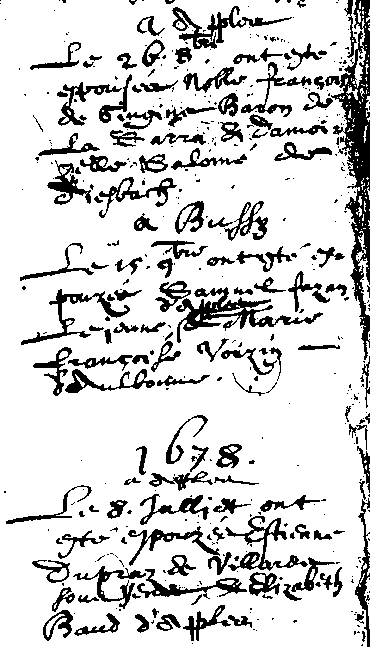
             A Apples
Le 26 8bre. ont esté
  espousés Noble françois
  de Gingins Baron de
  La Sarra & Damoi-
  selle Salomé de
  Diesbach.
             A Bussy
Le 15 9bre. ont esté es-
  pouzés Samuel fazan
  Le jeune d'Apples, & Marie
  françoise Voizin
  d'Aulbonne.
               1678
             A Apples
Le 8 Juillet ont
  esté espouzés Estienne
  Dupraz de Villards
  sous Yens, & Elizabeth
  Baud d'Apples.
             At Apples
The 26th October were
  married Noble François
  de Gingins Baron of
  La Sarra & Miss Salomé de
  Diesbach.
             At Bussy
The 15th November were mar-
  ried Samuel Fazan
  The younger of Apples, & Marie
  Françoise Voizin
  of Aubonne.
               1678
             At Apples
The 8th July were
  married Etienne
  Dupraz of Villards-
  sous-Yens, & Elizabeth
  Baud of Apples.
This is a typical 17th Century hand - and typically swift and messy. The spelling is a little haphazard, but not too different from modern French.
There are only two abbreviations here, the names of the months October and November. These are easy to remember provided you keep in mind that October comes from the Latin word meaning 8, November from 9, December from 10, etc. Note the old spelling of Aubonne, "Aulbonne".
When noble families are involved, such as de Gingins or de Diesbach (known in the German-speaking areas as von Diesbach), it is often possible to find a great deal of information in the various historical encyclopedias and genealogical compendia. Surnames beginning with "de" may or may not be considered noble, and there are many families who were granted arms at a later date who never used the "de". The best indicator is the word Noble, or the abbreviation "N.". For really important nobles, one may find "Noble et Puissant" ("N. & P.", noble and powerful), "Noble et Genereux" ("N. & G.", noble and generous), or "Noble et Vertueux" ("N. & V.", noble and virtuous), though it is an open question whether the people so identified were any more powerful, generous, or virtuous than their neighbors. Even if you can't find anything about the family de Gingins, the record indicates he was Baron of La Sarra. You would look up La Sarra in one of the historical encyclopedias, where you would eventually figure out that its modern spelling is La Sarraz (a bit north of Cossonay, and famous for its Horse Museum), leading to a list of all the noble families that owned the fief and probably details of their relationships to each other. You would also likely learn the names of the other properties of the family, useful clues for additional parish registers to be searched!
To distinguish people of the same name from each other, it was customary to add something at the end of the name. We might find something like "Le jeune" (the younger), "L'ainé" (or the older spelling L'aisné, meaning the elder), even sometimes "Le moyen" (the middle). These terms refer only the relative age of the people who had the same name, there is no indication that they are father and son. In fact, there are examples of two sons of the same parents having the same given name. Thus, Jean Fisican L'aisné was the older brother of Jean Fisican Le jeune in the village of Corcelles-près-Payerne in the late 16th Century. Another way to distinguish people was to indicate their parentage: we might find Claude Mayor fils de Pierre Mayor and Claude Mayor fils de feu Claude Mayor mentioned in the same record. But the purpose of these citations is never to provide modern readers with a pedigree; there is only enough detail to indicate to the person who wrote the record which Claude or Jean he was talking about. Note that a person identified as "Jean Favre le jeune" could also be identified in another record as "Jean Favre fils de Humbert Favre", and at a later date, when he has become the patriarch of the Favre clan, he could eventually be called "Jean Favre l'aisné"!