JEUX
William Byrd, The Carman's Whistle (mp3)
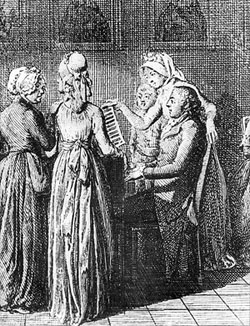
Pages devoted to my favorite harpsichord music, realized for General MIDI. I have tried to limit these to unfamiliar pieces that are not as well known as they should be. Unfortunately, the quality of the GM Harpsichord patch varies tremendously, and I have yet to find one that reproduces the seductive quality of the best instruments. Part of the problem is that most samples have been recorded far too close to the instrument, producing a very noisy attack.
For my own use, I have modified a patch from the Chaos GM soundfont, increasing the length of time that a held note continues to sound, and decreasing some of the attack noise. With a little more work, this experiment has led to a new Hpschd soundfont. The new soundfont will be available for downloading on the HammerSound web site. If you load it in bank 40, you will be able to play the MIDI arrangements that I will be posting here. Click to see the stop list and other details.
The first section below contains GM realizations of harpsichord music; the bottom section of this page is reserved for pieces
realized for the Hpschd SoundFont.
—John W. McCoy
General MIDI (GM) Realizations
French Harpsichord Music
- François Couperin: "L'Ame en Peine" (The Anguished Soul)
- François Couperin: "Le Tic-Toc-Choc, ou Les Maillotins" (untranslatable, appears to refer to a toy)
- Jean-Henri d'Anglebert: "Tombeau de M. de Chambonnières" (In Memory of M. de Chambonnières)
German Harpsichord Music
- J. S. Bach: Prelude in A minor(BWV 922) and Fugue in A minor (BWV 959)
- W. F. Bach: Twelve Polonaises (Those highlighted are now available, the rest to appear later until the whole set is realized.)
Italian Harpsichord Music
- Alessandro Poglietti: "Aria allemagna con alcune variazioni sopra l'età della Maestà Vostra" —
"German aria with some variations on the age of Your Majesty", composed for the birthday of the third wife of Emperor Leopold I,
the number of variations corresponding to her age, and the individual variations depicting characteristic instruments or vignettes
of the different nations of the Hapsburg Empire. This realization has the intended instruments join in the fun, and the MIDI format
allows us to overcome all technical difficulties in the original score.
Here are the subtitles that explain the individual variations:
- Aria Allemagna con alcuni Variazioni sopra l'Età della Maestà Vostra
- (without designation)
- (without designation)
- Soggetto Rivoltato (voices reversed, relative to the previous variation)
- Lyra (Lira, an early form of the Viola)
- (without designation)
- (without designation)
- Böhmisch. Dudlsackh (Bohemian bagpipes)
- Holländisch. Flagolett (Dutch flageolet)
- (without designation)
- Bayrische Schalmay (Bavarian shawms)
- (without designation)
- Alter Weiber Conduct (old women's procession)
- Hanacken Ehrentanz (celebration dance from the Hanack region, now in the Czech Republic)
- Französische Baiselemens ("baiser les mains" or kissing of hands, in the French style)
- Gaugler Seiltantz (juggler's tight-rope dance)
- Polnischer Sablschertz (Polish saber play)
- Soldaten Schwebelpfeif (soldiers' fifes)
- Ungarische Geigen (Hungarian violins)
- Steyermarkher Horn (Styrian horns)
English Harpsichord Music
- John Bull: The King's Hunt
- William Byrd: The Ghost
Polish Harpsichord Music
- Anonymous: Passomezzo
- Diomedes Cato: Gagliarda
Realizations for the Hpschd SoundFont
Dutch Harpsichord Music
About the same time as the Fitzwilliam collection in England, there were similar keyboard works being written into Dutch virginals collections. In some cases, the tunes are the same, but the settings are different. Most are anonymous. The most popular tune seems to be "Daphne", which shows up in many forms, here as a Courant "Daphne", along with another popular ditty, Rosemont.
English Harpsichord Music
- William Byrd:
- "The Ghost" (Play MP3)
- "The Carman's Whistle" (for MP3 file, see at the top of this page)
- John Bull: "The King's Hunt" (Play MP3)
- Giles Farnaby: "The Old Spagnoletta" (Play MP3), one of the most popular tunes of all time
- Henry Purcell: Ground in C minor (Play MP3)
German Harpsichord Music
- J. S. Bach: Prelude in A minor (BWV 922) (Play MP3) and Fugue in A minor (BWV 959) (Play MP3)
- J. S. Bach: Concerto 16, after Vivaldi (BWV 972), Allegro (Play MP3), Larghetto (Play MP3), Allegro (Play MP3). This is the concerto for solo harpsichord made famous in the 20th Century by Wanda Landowska. She played it her way, and that was just fine. There is even kinescope footage of her playing it: she hovers almost motionless over the great Pleyel machine, while glorious music pours forth.
- J. S. Bach: Goldberg Variations (Play MP3), with all the repeats, no funny business, but making full use of the instrument. The complete piece runs almost 83 minutes, the MP3 file is huge.
- J. S. Bach: The Well-Tempered Clavier, MP3 files from Book 1: C Major, C Minor, C# Major, C# Minor, D Major, D Minor, Eb Major, D# Minor, E Major, E Minor, F Major.
- W. F. Bach: Twelve Polonaises:
French Harpsichord Music
- François Couperin: "Le Tic-Toc-Choc, ou Les Maillotins" (untranslatable, appears to refer to a toy)
- François Couperin: "Le Moucheron" (Play MP3), The Gnat, an amusing descriptive piece
- François Couperin: "Musette de Choisi" (Play MP3) and "Musette de Taverni" (Play MP3), both musettes are written as 3-handed pieces, here realized for two harpsichords
- François Couperin: Carillon de Cithère (Play MP3) In myth, Cythera was the island where Venus first came ashore, after she was born from the sea foam as depicted by Boticelli (his painting also known as "Venus on the Half-Shell"). Later myth had Cythera as an island of pure love, beckoning to elegant party-goers as depicted by Watteau. Couperin imagines a carillon that summons us thither.
- François Couperin: "Les Fastes de la Grande et Ancienne Mxnxstrxndxsx", if you don't know the story on this suite, and to download the five movements, click on the title for the explanations!
- François Couperin: "Les Barricades Mystérieuses" (Play MP3), The Mysterious Barricades—perhaps the most mysterious part is the title itself; are these the subtle barriers that keep us apart?
- Jean-Henri d'Anglebert
- Suite in D Major: ZIP file containing MIDI files for the complete suite.
- Suite in D Minor: ZIP file containing MIDI files for the complete suite.
- Prélude (Play MP3)
- Allemande (Play MP3)
- Courante (Play MP3)
- Double (Play MP3)
- 2me Courante (Play MP3)
- Sarabande Grave (Play MP3)
- Sarabande (Play MP3)
- Gigue (Play MP3)
- Gaillarde (Play MP3)
- Gavotte (Play MP3)
- Menuet (Play MP3)
- Ouverture de Proserpine (Play MP3)
- Folies d'Espagne (Play MP3) (An elaborate set of variations on La Folia, seldom performed, but here absolutely complete)
- Passacaille d'Armide (Play MP3)
Italian Harpsichord Music
- Domenico Scarlatti